





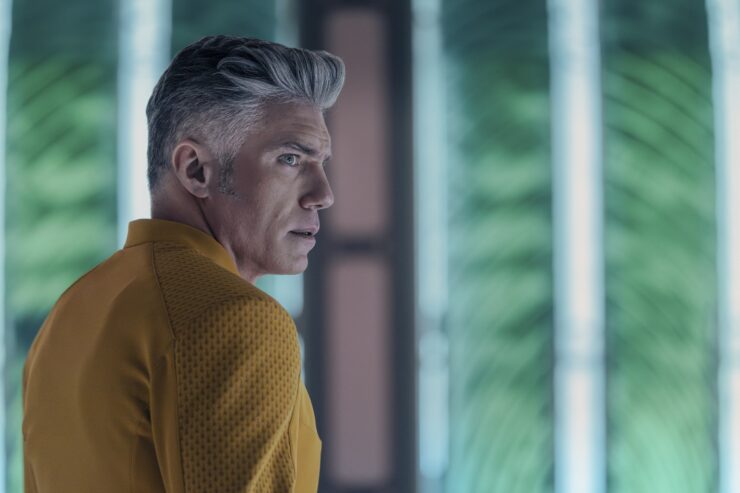
Strange New Worlds is back, both literally and figuratively.
The literally part is obvious: the fourth season debuted today with “Valles Marineris.” The figuratively part is much more encouraging: after a hit-and-miss third season, the fourth season debuts with a truly superb episode.
One of the landmines that SNW has had to deal with is the fact that it’s a prequel to a beloved show, and all too often the writers have stepped on those landmines to poor effect, focusing way too much on goofing around with fan theories and hey-this’ll-be-cool moments and sub-referencing over and over again and not enough on telling stories about a starship exploring space.
“Valles Marineris” is one hundred percent about a starship exploring space, and it’s fantastic. The Enterprise is assigned to examine a rare phenomenon, an interstellar squall. It has appeared around a star with no explanation, and the Enterprise is to study it for as long as it lasts (they’re usually, according to Spock, gone quickly). Pelia is the only person on board who has seen one before, and she says she may have been in a phone box when it happened. (Okay, I know I said it was one hundred percent about a starship exploring space, but I should’ve said ninety-nine percent, because that was totally goofing around with fan theories, as this is the latest unsubtle hint that Pelia has traveled with the title character from Doctor Who.)
Of course, things go horribly wrong, because if things didn’t go horribly wrong, we wouldn’t be interested in watching a TV episode devoted to it. They detect a distress call from a buoy, and they go in to investigate. The field chooses then to expand, of course, keeping them from making it out—and then when they do come out, the ship is rendered almost completely powerless. Even if they can fix the warp engines, they don’t have any uridium to ignite the engines. Worse, they have no idea where they are. There are three M-class planets in the system they’re in, at least, and one of them has uridium, so Number One, Ortegas, and La’an take a shuttlecraft to that planet to collect the uridium.
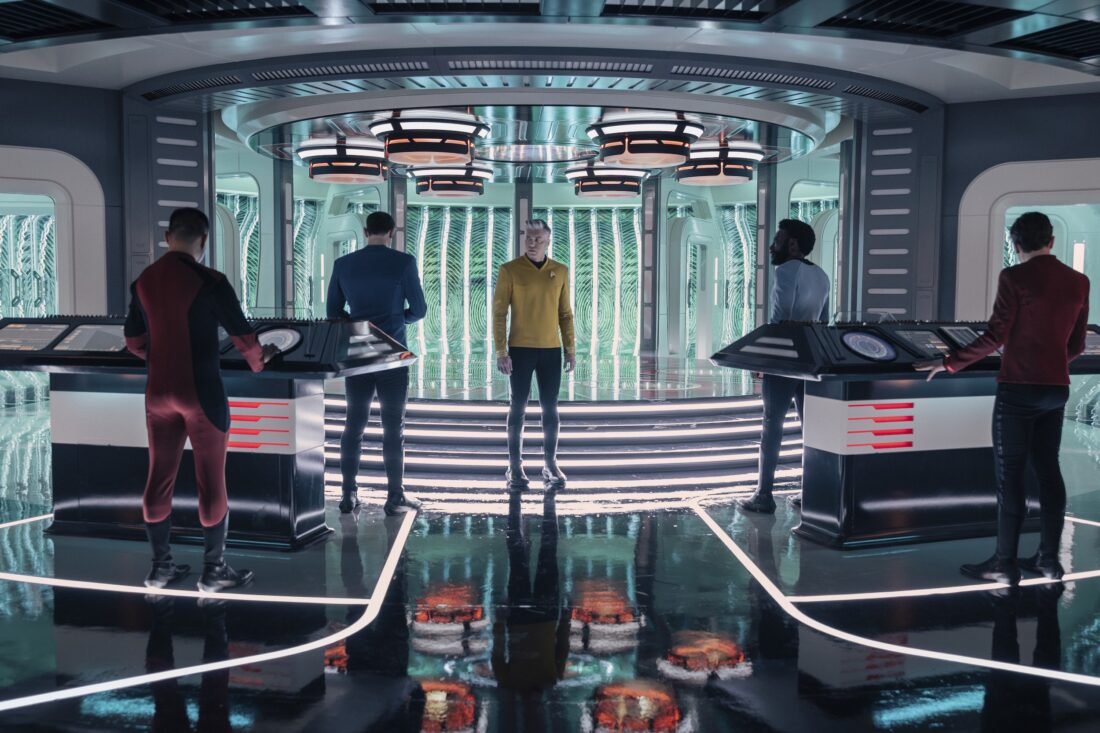
Meanwhile, on the Enterprise, repairs are interrupted by a ship snagging them in a very sophisticated tractor beam and announcing that they’re salvage. Pike tries to reason with Battle Commander Cassell (superlatively played by Saffron Burrows), and he eventually convinces her to come on board to talk.
One of the more tired complaints about the current crop of Trek shows is that the producers of same don’t understand Star Trek. One of the things I’ve tried to make clear in my reviews of those shows is that that particular complaint is utter nonsense. With this episode of SNW, we have another piece of evidence to support that they understand Trek just fine, thanks, as we see some magnificent exchanges between Anson Mount’s Pike and Burrows’ Cassell. Throughout those exchanges, Pike is constantly putting forth the Trek ethos of communication over conflict, of understanding over violence. Cassell’s people—who look very Vulcanoid—are in conflict with the Dol’Drm, an insectoid species from a neighboring planet. While Cassell’s people have a lot of impressive technology—for example, they can phase through solid matter—they don’t have faster-than-light travel and they don’t have universal translators. Pike offers to help them communicate properly with the Dol’Drm, something they’ve never been able to do. It might lead to peace.
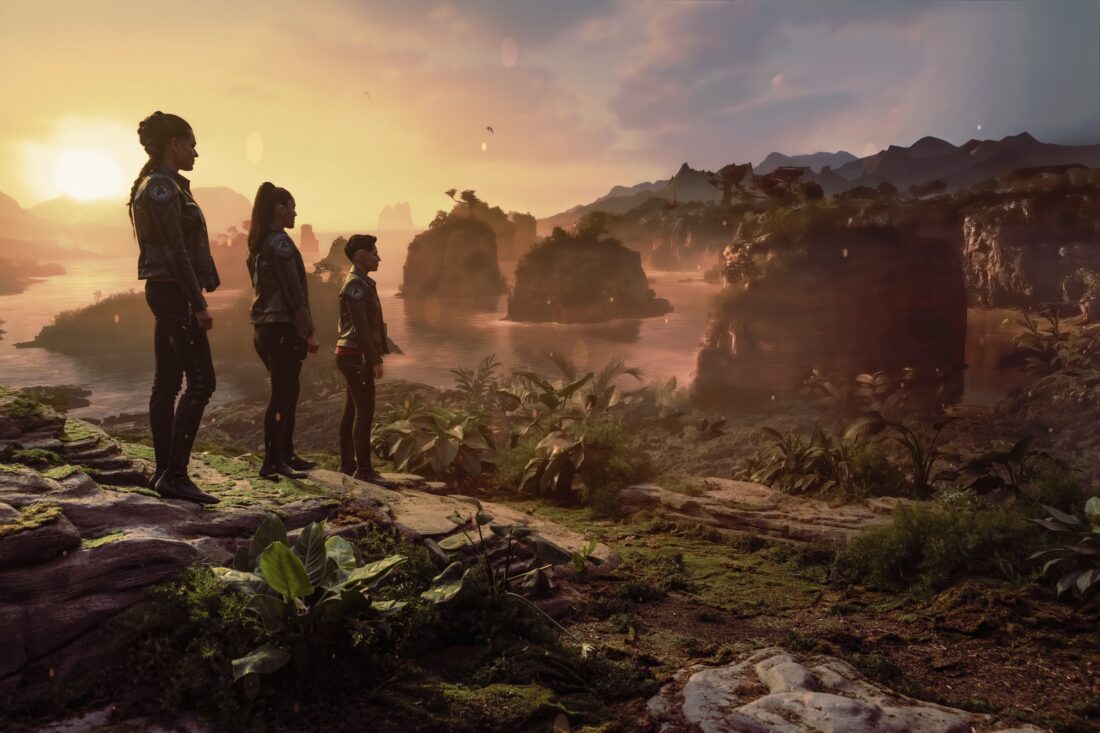
But there’s a wrinkle to all this: Spock determines the Enterprise’s location in space—and, unfortunately, in time. They’re in the Sol system, 65 million years in the past. The planet Cassell came from is Mars and the planet on which the landing party is fetching uridium is Earth.
Which means that the very large creature that the landing party is trying to get past is a dinosaur.
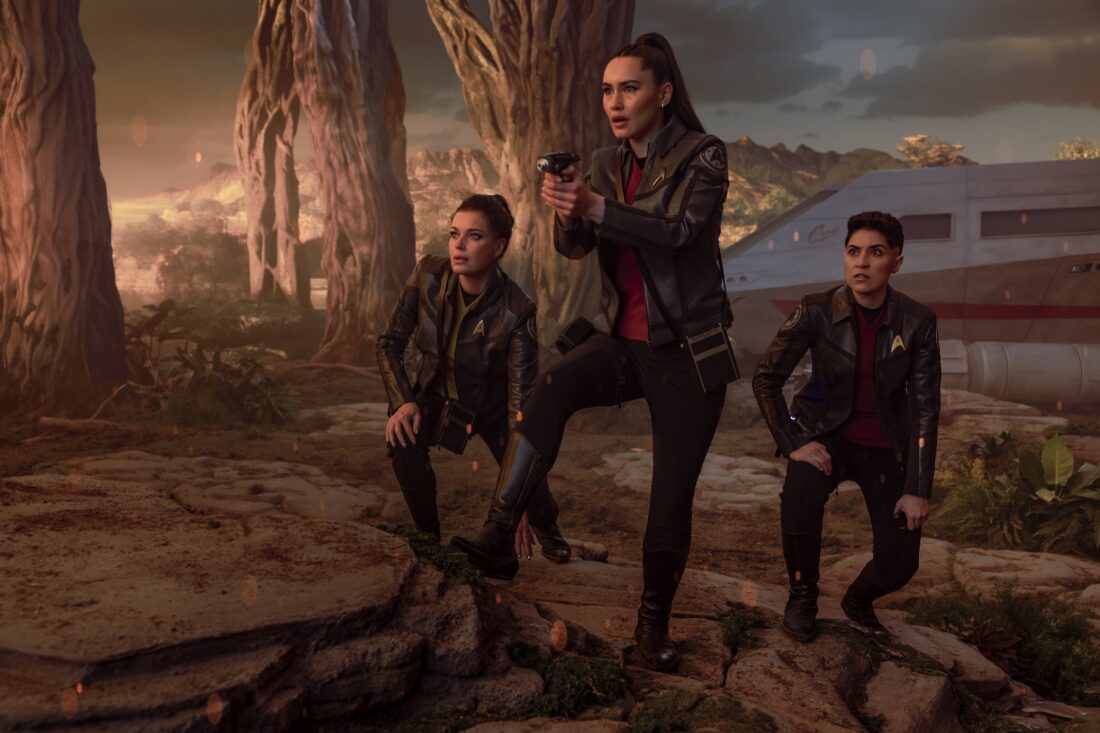
So now we get some fun cutting back and forth between Pike trying to convince Cassell not to salvage his ship on the Enterprise and Number One, La’an, and Ortegas trying to be careful not to step on any butterflies. (They don’t actually mention Ray Bradbury’s “A Sound of Thunder,” but you can tell that all three of them have read it.)
The stuff on prehistoric Earth is tremendous fun, as they try to figure out ways of dealing with the dinosaurs that don’t involve killing them. (Solutions they wind up using including Number One firing a phaser on stun to the soft palate inside a Tyrannosaur’s mouth and La’an punching a raptor in the head, which impresses everyone with its effectiveness, especially La’an herself…)
Unfortunately, Pike’s attempt at helping mediate a peace between the Martians and the Dol’Drm fails when Cassell learns that the Enterprise is from the far future, something Pike goes out of his way not to mention. And in that future, Mars is a dead world that Pike’s own people only made habitable by terraforming. The giant crater known to us as Valles Marineris was created by a Dol’Drm weapon that killed millions, and left a permanent scar on Mars. Cassell wasn’t entirely sold on communication, and finding out that Pike lied to her burns out any interest she had in doing so.
Instead, they steal the Enterprise’s antimatter containment unit, intending to use it to destroy the Dol’Drm homeworld.
The landing party returns with uridium—which came from a crashed Dol’Drm ship, as it happens—and is able to power up the Enterprise.
(Brief digression: the Enterprise is still able to power up because they have a backup antimatter containment unit, and I wanted to dance a damn jig when that happened, because something that has driven me crazy about so many science fiction shows, the various Treks among them, is ships that are on allegedly long-term missions far from home, yet don’t have spare parts for important things. So it was extremely gratifying to see an actual spare part, and nobody even makes a fuss.)
With sensors back at full bore, Spock is able to determine that the Dol’Drm come from the fifth planet—not Jupiter, rather another planet about the same size as Mars that is between Mars and Jupiter.
The Enterprise moves to try to intercept Cassell’s ship to stop her from using the antimatter to blow up the Dol’Drm homeworld.
And then at the last minute, Pike orders everyone to stand down. The presence of a fifth planet changes everything, and Pike realizes it just barely in time.
It’s an awful, horrible decision. It’s one that visibly affects everyone on board. But it’s also the only decision possible. Because he knows that 65 million years in the future, there is an asteroid belt between Jupiter and Mars.
Which means that everyone has to watch as an entire world—an entire civilization—is destroyed before their eyes. As is a ship full of Martians, as Cassell’s was a suicide mission, her own ship caught in the wake of the explosion.
However, the explosion also provides the energy the Enterprise needs to get back to the twenty-third century, and they do so, creating the very squall they were sent to investigate. (Also the distress buoy they picked up was their own, sent after they lost power.) Spock confirms that the Dol’Drm homeworld is now the asteroid belt, but also that one piece of debris from the explosion struck Earth and created the extinction-level explosion that wiped out the dinosaurs. In addition, Mars’ orbit was changed, which resulted in destroying the planet’s atmosphere.
The episode doesn’t softpedal the awfulness of the decision Pike has to make here. Oftentimes, doing nothing can be the worst thing to do—but in this case, it’s necessary. Pike of all people knows the inevitability of the future. And yet, these are also all people who, from their perspective, have been dead for 65 million years, and would be regardless of Pike’s actions.
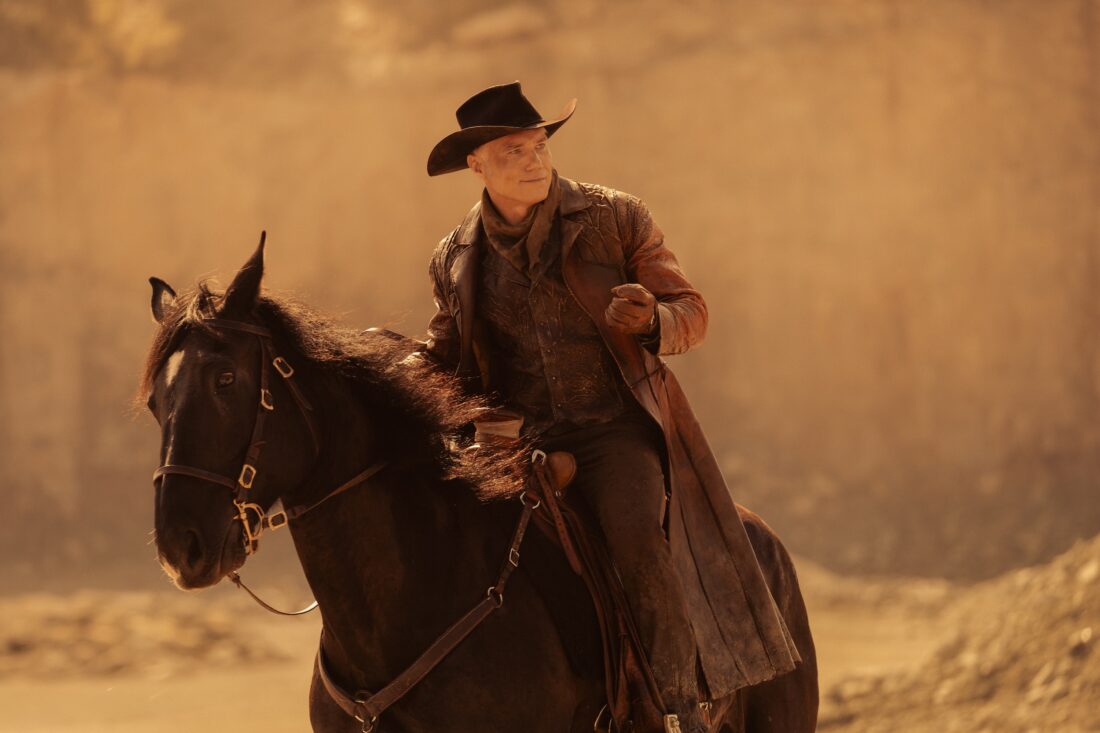
Truly, this episode has everything. There’s the cool CGI adventure with Number One and the gang fighting dinosaurs. There’s Pike’s very Trekkish pleading for Cassell to try to talk to her enemies. There’s Cassell’s obvious desire to try peace swimming upstream against the long, dreadful war that she’s spent a lifetime fighting—and ultimately losing that fight thanks to Pike’s lie-by-omission. (I can’t say enough about the dignity and gravitas that Burrows imbues Cassell with, aided by a superlative script, credited to executive producers Akiva Goldsman & Henry Alonso Myers, off a story bv Myers and co-executive producer Alan B. McElroy.) And there’s even fun with space cowboys, as the opening has Pike, M’Benga, and La’an riding horses on an alien planet, where they’re delivering supplies covertly, which is mostly there to put the time Mount spent on Hell on Wheels perfecting his equestrianism to good use.
There are some lovely little touches here, more subtle than Pelia’s phone-box line. The Martians are Vulcanoid, and in the early concepts of Star Trek, Spock was supposed to be Martian. On top of that, M’Benga points out that the DNA he detected in Cassell and her people can be found in many Alpha Quadrant species—which is a continuity hit, believe it or not! In “Return to Tomorrow,” Spock mentions the Vulcan theories that their species might have originated on another planet. In that context, he thinks it might be Sargon’s people who did it, but it could be the Martians, also. (For that matter, Cassell’s descendants could possibly be Sargon’s people also.)
And we continue to see that this is a younger Scotty, as he’s been putting in alert lights whenever Ortegas pushes the engines beyond their specs. I love the fact that Scotty was conservative in his younger days. Just in general, the show has done an excellent job of showing us younger versions of the characters we know, and seeing the process by which they evolve into the ones we’re more familiar with from the show that aired sixty years ago.
The story is very pulp-y, it’s true. The notion of the asteroid belt being a planet that was destroyed in a war with Mars (or with another solar planet) is one that has whiskers on it, as is the notion of life on Mars. Indeed, the episode itself calls back to Edgar Rice Burroughs’ A Princess of Mars, the novel that introduced John Carter and chronicled his trip to Mars (or Barsoom, as the locals called it).
Speaking of tired tropes, we also have April offering Pike a promotion to commodore at the top of the episode and Pike refusing it at the end, which is one of Trek’s more boring clichés. Although it does result in Number One getting a promotion to full commander, which is good to see. In addition, Uhura is mentoring a Vulcan cadet who is spectacularly snotty even by Vulcan standards, and I spent pretty much every scene she was in waiting in vain for Uhura to upbraid her for speaking out of turn to an officer, which a properly trained cadet would never do, yet which she did constantly.
Still—SNW is back! And in both senses, it’s about damn time…


I’m at the point where, every time I see characters go back in time to meet dinosaurs, I immediately think “Oh here we go, they’re going to cause the extinction”; and, of course, that was exactly what happened. So this episode isn’t exactly setting the world on fire for its original concept. I also wasn’t overly enamoured of its execution: if the lesson that Pike needs to learn is that he needs to live in the moment, then surely his reaction should be to try to save the Dol’drm, regardless of what history might mandate, and the tragedy would be his inability to do that for whatever reason.
That said, I will give it points for being an actual science fiction story with moral weight to it, which too much of season 3 was not; and for Cassell giving us a complex and sympathetic antagonist. And for La’an punching a Deinonychus, which was cool.
“I also wasn’t overly enamoured of its execution: if the lesson that Pike needs to learn is that he needs to live in the moment, then surely his reaction should be to try to save the Dol’drm, regardless of what history might mandate, and the tragedy would be his inability to do that for whatever reason.”
I think the idea was that Pike felt guilty about prioritizing humanity’s future and sacrificing the Martians’ and Dol’Drm’s present, so he wanted to focus on living in the moment going forward from there.
It would be nice to see more stories about dinosaurs that didn’t huddle around the K-T extinction event but instead explored the vast 150-million-year history before it. Although I think we’re too fixated on dinosaurs and pay too little attention to all the creatures that lived before and after their era. (The series Primeval and the earlier Walking with… pseudo-documentary shows from the same production company were rare exceptions to that.)
Keith, they weren’t saying “uridium,” which is an imaginary mineral mentioned in DS9, but iridium, undoubtedly as a play on the fact that the iridium layer at the Cretaceous/Tertiary boundary is how we know an asteroid hit the Earth 66 million years ago (the “65 million” figure is outdated), because iridium is more common in asteroids than in Earth’s crust. As soon as they started talking about finding iridium on the crashed ship, I said to myself, “Yep, the ship is going to blow up and kill the dinosaurs,” though as it turned out, I was a little bit off.
But the iridium detail, in and of itself, is a microcosm for why this episode drove me crazy. You say it was true to Star Trek‘s spirit, and sure, when it came to the peace and understanding stuff, that’s true. But one thing Gene Roddenberry strove for in Star Trek was to get the science right, or at least to get it less wrong than all the other SFTV shows of the day. And this episode fell short of that ideal possibly worse than any other Star Trek episode or film I’ve ever seen, which is really saying something. The science here was so incredibly bad and wrong and outdated on every level.
I mean, the least of it is that, if iridium is more common in asteroids, they obviously shouldn’t have needed to go to a planet’s surface to find some. Also, why the hell would they need iridium to activate the warp engines, and why wouldn’t they have replacement parts aboard? But so much else is wrong. Mars wasn’t habitable as recently as 65 million years ago — more like 3.5 billion. Which is also the age of Valles Marineris, which is not an impact crater but a tectonically formed rift valley that makes the Grand Canyon look like a pothole. And the idea that the asteroid belt was formed from an exploded planet was debunked decades ago. Not to mention that a portable antimatter pod from a starship would not be remotely near big enough to blow apart a whole planet. Not to mention the idea that the Enterprise has only one antimatter pod powering the engine at any given time and it’s the size of a suitcase is ridiculous. The tech manuals and cutaways published over the decades show starships having dozens of antimatter pods each the size of a large van, since they need enough fuel to sustain a ship for years.
And then there’s the attempt to pass off Pike’s key insight about the fifth planet as somehow not screamingly obvious. I mean, everyone knows there’s an asteroid belt there now, and everyone knows Mars is uninhabitable now, so it should’ve been clear to everyone going in that what Cassell was trying to do was already established history. Even talking to her about trying to stop the Dol’Drm from destroying Mars contradicted what Pike said about not trying to change history. And if they knew they were 65 million years in the past (which would actually be a million years after the dinosaurs died out, but never mind), they must’ve known the impact would be soon, so the landing party could’ve stepped on all the figurative or literal butterflies they wanted without having any real effect on the future. So not only was the whole story a massive failure of research, but it made all the characters carry idiot balls to make the plot work.
It was also hard to buy into the emotional arc for Pike and Cassell when Cassell was written as such a one-note character for much of the story, a stuck record talking about weapons every third sentence. Okay, she gained nuance later, but the way her initial militancy was written was so caricatured and heavy-handed that it tainted the whole thing.
Meanwhile, I guess there’s no point in acknowledging the inconsistency with “The Naked Time” where Spock reacted to the ship’s brief time travel as if it were a new discovery. File that in the same category as Spock saying in “Dagger of the Mind” that he’d never melded with a human.
I’m also so very tired of the modern shows’ treatment of interstellar travel as a quick commute whereby you can get an assignment in person from an admiral, go do the mission, and then be back home to talk about it by evening. The whole reason Roddenberry called it Star Trek was because he wanted to portray interstellar travel as a long, challenging journey, and to portray a frontier narrative where the crew was far from home and thus had to rely on themselves and make all the crucial decisions themselves.
Anyway, the idea of the Enterprise crew meeting dinosaurs was already done far better than this, in the 1995 novel Star Trek: First Frontier by Diane Carey and paleontologist Dr. James I. Kirkland. (Yes, there’s a Trek novel cowritten by James Kirkland.) It’s a terrific adventure novel and far more scientifically plausible than this was. Some of its paleontology is out of date (for instance, no feathers on the dinosaurs), but it was accurate at the time, which is a hell of a lot more than “Valles Marineris” can say.
Not a fan. I think this was a work that resulted in Pike abetting genocide to help his species survive. The anti-matter weapons were his after all and used to commit murder. I also feel like a fantastic opportunity was lost to have the Martian captain realize she’s responsible for her planet’s destruction. I also feel like it’s going to be implied Sargon’s people or the Vulcans are descended from the Martians.
I also feel like she’s less sympathetic than she might be because 2,000,000 of her people dying is terrible but that strongly implies that it’s not a continuous state of war and she’s doing something more akin to avenging Pearl Harbor.
They were trying to give Pike his own “Edith Keeler” moment, realizing he had to let a past death happen to save the future, but the premise was just so over-the-top that it didn’t have the same impact. Plus “let an alien race I’ve never met die to save the world I know” doesn’t have the same personal resonance as “Let the woman I love die to save the world I know.”
It’s kind of funny that you note this as being an Edith Keeler moment for Pike because I definitely had that sense in a much different way. For me, Pike was essentially the Edith Keeler character with the “right ideas at the wrong time.” His instinct is to save everyone he can because it’s the right and humane thing to do. He’s going to broker peace to save lives in a past moment without really thinking about what that means right up until the last second. If he saves the Dol’drm, he annihilates his entire reality in much the same way Kirk would’ve done had he saved Edith Keeler from the fate that – in his time – she had already had. Pike made the only decision he could – and I think it would’ve robbed the story of something to have the Enterprise crew somehow try and fail to stop the Martians rather than to have to make the awful decision to stand back and let the awful thing happen that will save their reality.
As for the science, I will quite happily take “good story” over “good science” 8 days a week, 25 hours a day. I will take Pike struggling over a moral quandary in the moment and the toll that making a “right-but-also-wrong” decision over a story that somehow maintains scientific accuracy at the expense of that.
I also liked that it was the rare story that gave nearly everyone something important to do and some time on screen to do it.
I do think that this episode was important for Pike, in that he’s realized that there’s no way to avoid feeling the losses of past trauma and no way to avoid the terminal condition that’s coming. “The now” is the best of what he has, and if he lets that go or wastes it with avoidance and excessive worry, he and those around him will be negatively impacted. I think Una’s promotion was likely one of those things that fell by the wayside while he was on his six-month-long “lost weekend.”
“I think it would’ve robbed the story of something to have the Enterprise crew somehow try and fail to stop the Martians rather than to have to make the awful decision to stand back and let the awful thing happen that will save their reality.”
The problem is, it should never have come to that. As soon as the characters realized these were Martians trying to prevent their world from becoming a dead planet, they should’ve immediately known “Uhh, we can’t help them, based on Pike’s own explicit order to do nothing that could change our past.” But instead, they forgot all about that issue until the critical moment when Pike suddenly remembered the existence of the Asteroid Belt, which somehow came as a surprise to everyone else.
And what a cool story that could’ve made — if the characters had realized immediately that they couldn’t help Cassell, and had had to try to come to a peaceful understanding with her while having to hide their certainty that she had to fail. If Pike had known all along that he had to stop her, that he couldn’t even try to help end the war no matter how much he wanted to.
Although it still would’ve been an utterly stupid premise based on not knowing the difference between 65 million years and 3.5 billion, or the difference between a crater and a rift canyon, or that the theory of an exploded planet forming the Asteroid Belt is even more antiquated than the idea of jungles on Venus. It’s a corny idea on the level of a Gold Key comic book.
See, that’s the thing – they were working on instinct and Pike and the rest of the crew were too tired and distracted from six months of relentless work and unprocessed grief to realize it. This crew is one that nearly always makes the big save. How many times have we seen the Enterprise swoop in to save a little guy against a bigger one, even before they fully know what’s going on? It’s almost always the right thing to do. In this case, it’s not but because this is the eradication of a race – and Cassell has been so sympathetic that our instinct is almost to stay the final blow for her sake – they react wrongly right up until the last second. That’s when Pike realizes this has to happen or everything they know will cease to exist. Good stories don’t always occur when our heroes do only the right or smartest thing.
I don’t buy that. Trained Starfleet officers, no matter how tired, would not forget basic factual information like “Mars is lifeless” and “the Asteroid Belt exists.” Hell, a third-grader should know those things off the top of their head. A member of a space service forgetting those things is like a member of the Navy forgetting that you can’t breathe underwater.
Again, it’s not a matter of “forgetting” the fifth planet doesn’t exist. Pike knows it’s gone in his lifetime (as is the Martian civilization). The real question is whether the Dol’drm and their world were meant to die in this moment – a moment in which he could respond to his natural inclination and save them. It’s only at the last second that he has the “hunch” that the Dol’drm and their world must die at that moment and makes the awful decision to let it happen. Before then, for all he knew, the Dol’drm had thousands more years ahead of them before something brought their world to an end.
I was already going to post in order to mention this, but I find I’m essentially just backing up CLB: the subtitles told me that the element they are seeking to repair the ship is iridium with the first letter an “i”, not uridium.
I really liked this episode. Very Trekkie. My biggest complaint was that when they revealed where they wound up I knew – I 100% knew the extinction asteroid was going to be involved at the end… Would have been nice if they could have been a little more facile about when they were until the denouement .
My take: this was a long overdue look into Christopher Pike the captain. Sure, we’ve spent plenty of time with Pike as the friendly father figure who makes dinners for the crew. But other than that one moment in the season 2 finale cliffhanger (which always felt artificial and constructed) where they ask him how to get out of that quagmire, we’ve never really spent that much time with Pike grappling with the difficulties of making decisions. As far as I can remember, his last real questioning look into the burden of being a captain was in “The Cage”. With Batel out of the picture, we finally get some of that here.
And as far as first impressions go, “Valles Marineris” makes quite the banger of a first impression, both visually and in the audio department (both the cinematic sound effects and Melumad’s soundtrack were packing a serious punch last night). And if the behind the scenes accounts are accurate, there is clearly a focused effort from Goldsman, Alonso Myers and the writers involved to pivot away from season 3’s bigger creative swings, going for a more back to the basics approach.
Having listened to director Chris Fisher’s account on Cirroc Lofton’s 7th Rule podcast, it seems the story for this episode was the brainchild of Alan McElroy, who had this idea of starships meeting dinosaurs even long before he became a part of the current Trek era (before he joined Discovery 8 years ago in fact). So the notion of doing an advanced Mars civilization that existed before Earth probably wasn’t in that initial pitch. They settled on 65 million years before our time before figuring out the rest.
As a result, there were a couple of hiccups. The small one, unrelated to the plot, was the new Vulcan cadet. No way a student would get away with treating a superior officer with that level of condescension. You can do that with Spock and Tuvok – they’re senior officers.
The real big one is Una’s challenge to Pike’s decision to not fire. Obviously you want conflict in a scene like this, but it feels odd she didn’t remember that preserving the timeline meant losing the fifth planet and getting Mars to its inevitable desert decay. Maybe she and the crew had decided that their moral imperative to protect races from genocide meant damaging the timeline regardless?
The way I see it that whole chain of events was tied to a 15 second countdown, thus there was no time to really develop the arguments and differences of opinion between the crew. That was the issue.
If the episode had been rewritten so they’d be given, say, 10 minutes to argue before Pike’s decision, it would have probably patched these character logic holes and improved the sequence tremendously. We should have seen logical, thoughtful arguments from all sides regarding whether they should stop Cassell from committing genocide or not and whether protecting or tampeting with the timeline was their responsibility or not.
It’s also a bit odd that they frame Pike as making a blind decision based on instinct. The minute Cassell stole the antimatter, I figured blowing up the fifth planet would lead to the asteroid belt. I’m surprised on no one on the crew made that connection.
Those issues aside, this was a good focused season opener. A welcome return to the basics, and despite the logic holes in the Mars plot, it was the perfect opportunity to give us a Pike-centric episode.
I like the episode and I enjoy your review. This seems to be the year track goes to Dino’s and dragons. So far so good!
They also shouted out my favorite impact crater, Chicxulub (Google easter egg anim)